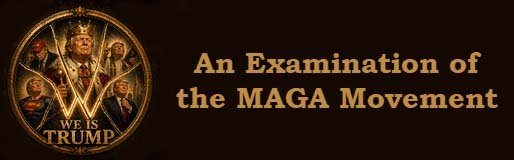
We Is Trump — The Book
By H. Jester Fieldstone
A provocative examination of Donald Trump, the MAGA movement, and the America that made both possible.
What if Donald Trump is not merely something that happened to America? What if, in some meaningful sense, he is something America produced?
We Is Trump is a work of political and cultural analysis that looks beyond Donald Trump himself to examine the America that produced, elevated, and sustained the movement around him.
These concepts are at the heart of We Is Trump by H. Jester Fieldstone.

Want the full analysis?
We Is Trump begins with a simple but uncomfortable premise:
Donald Trump cannot be fully understood by studying Donald Trump alone.
We Is Trump is now available on Amazon.
Book Details
Title: We Is Trump
Author: H. Jester Fieldstone
Publication date: August 26, 2026
Format: Kindle and Paperback
Pages: 349
ISBN: 979-8-90553-243-6
Available from: Amazon
The book looks beyond the personality, spectacle, controversies, victories, defeats, and endless arguments surrounding Donald Trump to examine something larger: the political culture that made his rise possible and the MAGA movement that grew around him.
It is easy to make Trump the entire story.
It is much harder to look in the mirror.
We Is Trump asks us to do exactly that.
What Is We Is Trump About?
Presidents do not emerge from nowhere. Political movements are not created in a vacuum. They grow inside societies already filled with grievances, ambitions, fears, loyalties, economic pressures, cultural conflicts, institutional weaknesses, technological changes, and competing versions of reality.
Trump did not invent American political polarization.
He did not invent resentment toward elites.
He did not invent distrust of government or journalism.
He did not invent celebrity culture, partisan media, social-media outrage, conspiracy theories, economic anxiety, cultural resentment, or the belief that America's institutions no longer work for ordinary people.
But he recognized many of those forces.
He amplified them.
He gave them language.
He gave them enemies.
And he helped transform them into one of the most powerful political movements in modern American life.
That movement became MAGA.
And that leads to the larger question behind the book:
If Trump is the reflection, what exactly is standing in front of the mirror?
Why “We Is Trump”?
The title is grammatically wrong on purpose.
“We are Trump” would be correct English.
“We Is Trump” is not.
It is supposed to bother you.
“We Are Trump” might sound like a political slogan or a declaration of allegiance. “We Is Trump” creates friction. Something is wrong. Something does not fit. The phrase demands an explanation.
And the explanation is central to the book.
The “we” does not mean that everyone supports Donald Trump.
It does not mean that every American is responsible for everything Trump has said or done.
It does not mean that Trump supporters and Trump opponents are morally or politically identical.
It means something more difficult.
Trump is part of a system that includes all of us.
Voters and nonvoters.
Republicans and Democrats.
Politicians and journalists.
Corporations and universities.
Churches and courts.
Social networks and algorithms.
Supporters, opponents, institutions, activists, donors, entertainers, commentators, and citizens.
A democracy is not merely the person occupying the presidency.
It is the culture capable of putting that person there.
That is why the title is We Is Trump.
More Than a Book About Donald Trump
There are already countless books about Donald Trump.
Books about his personality.
His campaigns.
His presidency.
His businesses.
His legal battles.
His political strategy.
His supporters.
His opponents.
His scandals.
His victories.
His failures.
We Is Trump asks a different question.
What does the existence of Donald Trump tell us about the country that produced him?
That question changes the focus.
Instead of looking only at Trump, the book examines the environment surrounding him.
Why did traditional political institutions prove so vulnerable to disruption?
Why did millions of Americans become willing to disregard political conventions that once seemed indispensable?
Why did distrust become such a powerful political currency?
Why did Americans increasingly divide themselves not simply according to policies, but according to competing cultures and competing realities?
Why did outrage become profitable?
Why did politics become entertainment—and entertainment become political?
Why did MAGA become something larger than a campaign slogan?
And if Donald Trump eventually leaves the political stage, do the forces that created Trumpism leave with him?
These are not questions about one man.
They are questions about a country. Our country.
The MAGA Movement and the American Mirror
At the center of We Is Trump is an examination of the MAGA movement—Make America Great Again—and what its extraordinary rise reveals about modern American politics.
To millions of supporters, MAGA represents a rejection of a political establishment they believe abandoned them.
It can represent stronger borders, national sovereignty, opposition to globalization, cultural conservatism, economic nationalism, distrust of government institutions, resistance to progressive social change, or simply the conviction that America's leaders stopped putting Americans first.
To its critics, MAGA can represent something profoundly different: political extremism, institutional distrust, democratic erosion, authoritarian impulses, misinformation, grievance politics, and a growing willingness to view political opponents not as fellow citizens but as enemies.
Both interpretations matter.
Because a political movement cannot be understood merely by repeating what its supporters say about it.
Nor can it be understood merely by repeating what its opponents say about it.
Understanding MAGA requires examining why millions of Americans found it compelling in the first place.
That is harder than caricature.
It is also more important.
What Made Trump Possible?
The easiest explanation for Trump is Trump.
His personality was unusual.
His media instincts were extraordinary.
His willingness to violate political conventions separated him from conventional candidates.
His ability to dominate attention was unlike anything modern American politics had seen.
But none of that explains everything.
A match cannot create a fire without something capable of burning.
Long before Trump's political rise, enormous changes were reshaping American life.
Manufacturing communities were transformed by globalization and automation.
Trust in government declined.
Traditional news organizations lost their gatekeeping power.
Cable television fragmented political audiences.
Social media demolished many remaining barriers between information, opinion, entertainment, rumor, and propaganda.
Cultural change accelerated.
Immigration became increasingly contentious.
Political parties became more ideologically divided.
Americans sorted themselves geographically, culturally, politically, and eventually epistemologically—living not merely with different opinions but increasingly with different versions of reality.
The economic shocks of the twenty-first century intensified insecurity.
Institutions that once commanded automatic respect increasingly had to compete for credibility.
Millions of Americans came to believe that the country's most powerful institutions neither understood them nor respected them.
Then Donald Trump arrived.
He did not create that America.
He discovered what could be done with it.
The Politics of the Mirror
One of the easiest habits in politics is finger pointing.
They did this.
They ruined the country.
They are ignorant.
They are corrupt.
They are dangerous.
They are the problem.
Every political tribe has a version of “they.”
The mirror asks a different question.
What did we contribute?
What did political parties reward?
What did television reward?
What did social media reward?
What did voters tolerate?
What did opponents unintentionally strengthen?
What did institutions ignore?
What did economic systems leave behind?
What did journalists misunderstand?
What did political leaders exploit?
What did ordinary Americans decide no longer mattered?
The point is not to distribute blame equally.
It is to recognize that history rarely provides us with the luxury of a single villain and a completely innocent audience.
Donald Trump matters.
The MAGA movement matters.
But so does the America in which both became possible.
Is We Is Trump Anti-Trump or Pro-Trump?
That question is understandable.
It is also narrower than the question the book wants to ask.
We Is Trump is a critical examination, not a campaign document and not a work of political devotion.
The book does not require the reader to admire Donald Trump.
It does not require the reader to despise him.
It asks the reader to look beyond the familiar argument in which every new Trump controversy becomes another opportunity for two political camps to repeat what they already believe.
The more interesting question is not simply:
What should we think about Trump?
It is:
What should we understand about ourselves because Trump happened?
Readers will reach their own judgments.
The book's job is to make the question harder to escape.
Why This Book Matters Beyond Donald Trump
Donald Trump will not remain the central figure in American politics forever.
The forces associated with his rise may last much longer.
Economic nationalism.
Institutional distrust.
Populism.
Political celebrity.
Cultural polarization.
Hostility toward political establishments.
The collapse of shared sources of information.
The use of outrage as an organizing tool.
The belief that political compromise is weakness.
The transformation of political identity into personal identity.
Those forces will not necessarily disappear when Trump does.
That is why understanding the MAGA movement matters beyond the career of the man who became its symbol.
And it is why We Is Trump is ultimately concerned with more than one presidency, one election, or one political party.
The book is about what happens to a democracy when citizens increasingly stop seeing one another as participants in the same national project.
Who Should Read We Is Trump?
We Is Trump is written for readers interested in Donald Trump, the MAGA movement, American democracy, political polarization, contemporary culture, media, populism, and the forces reshaping American political life.
But it is intended particularly for readers dissatisfied with easy explanations.
If your explanation for Trump begins and ends with the stupidity or wickedness of the other side, this book may make you uncomfortable.
That is intentional.
If you believe MAGA can be understood merely by labeling its supporters, the book asks you to look more closely.
If you believe every criticism of MAGA can simply be dismissed as partisan hostility, it asks you to look more closely as well.
And if you believe America's political crisis belongs entirely to somebody else—the mirror is waiting.
About H. Jester Fieldstone
H. Jester Fieldstone writes political satire and commentary that uses humor, exaggeration, irony, and cultural observation to examine American politics and the peculiarities of public life.
In We Is Trump, Fieldstone turns that perspective toward Donald Trump, the MAGA movement, and the American political culture surrounding them. However, this book is not humorous; it is indeed serious.
The result is not merely an examination of a politician.
It is an examination of the country looking at him.
The Mirror Is Larger Than the Man
Donald Trump may be the most recognizable face in the story.
The MAGA movement may be its most visible political expression.
But neither exists outside the America that made them possible.
We Is Trump asks the question hiding behind years of political arguments:
What if the story was never only about Trump?
What if the more difficult story is about the institutions we built, the incentives we created, the divisions we encouraged, the realities we chose, the grievances we ignored, the behavior we rewarded—and the country reflected back at us?
You can keep pointing at the man in the mirror.
Or you can look at the mirror itself.
We Is Trump
Are You Ready to Look in the Mirror?
Read the book! Donald Trump cannot be fully understood by studying Donald Trump alone.
We Is Trump is now available on Amazon.