What Does “We Is Trump” Mean?
“We Is Trump” means that Donald Trump is not simply an isolated political phenomenon. He is also a reflection of the culture, institutions, media, grievances, ambitions, fears, and choices that made his rise possible.
The phrase is deliberately grammatically wrong.
“We are Trump” would be proper English. “We Is Trump” is not.
That fracture is intentional.
It asks a more uncomfortable question than whether Donald Trump is good or bad, dangerous or misunderstood, a symptom or a cause:
What if Trump is not merely something that happened to America? What if, in some meaningful sense, Trump is something America produced?
That does not mean every American supports Donald Trump. It does not mean every voter identifies with the MAGA movement. And it certainly does not mean that everyone shares Trump’s politics, personality, rhetoric, or behavior.
It means that focusing exclusively on one man can prevent us from examining the larger conditions that made him possible.
That is the idea contained in three deliberately awkward words:
We Is Trump.

The Book Behind We Is Trump
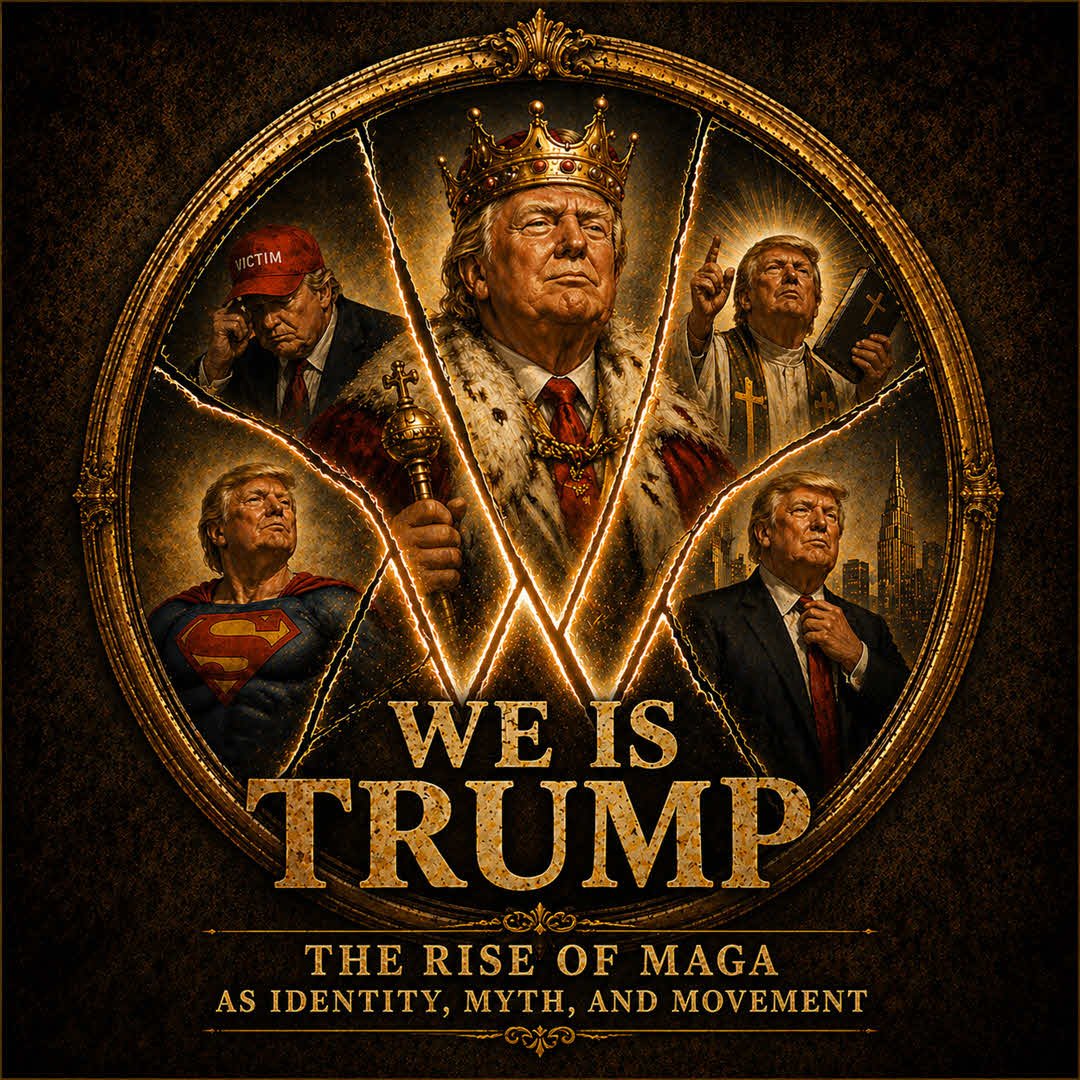
We Is Trump examines Donald Trump, the MAGA movement, and the America that made both possible. Rather than asking only what Trump has done to the country, it asks the more uncomfortable question: what does his rise reveal about us?
Trump as a Mirror
Political movements do not appear out of nowhere.
They grow inside existing cultures. They draw strength from existing grievances. They exploit divisions that already exist. They are shaped by institutions, technology, economics, media, personalities, history, and millions of individual choices.
Donald Trump did not invent political polarization.
He did not invent distrust of government, resentment toward elites, celebrity culture, partisan media, conspiracy theories, economic anxiety, political tribalism, or the desire for simple answers to complicated problems.
But he proved exceptionally capable of gathering many of those forces, giving them a political identity, and placing himself at their center.
That is why understanding We Is Trump requires more than understanding Donald Trump.
The man matters.
But so does the mirror.
“We Is Trump” Does Not Mean “Everyone Is Trump”
The phrase is intentionally provocative, but it is not meant literally.
We Is Trump does not mean that every American is responsible for everything Donald Trump has said or done.
It does not erase the enormous differences among Trump supporters, Trump opponents, Republicans, Democrats, independents, nonvoters, journalists, business leaders, political institutions, and ordinary citizens.
The word “we” points instead toward something broader.
A democracy is more than its elected officials.
It includes voters and nonvoters. Political parties and courts. Legislatures and corporations. Churches, universities, news organizations, donors, activists, commentators, algorithms, and social networks.
Presidents do not emerge outside that system.
They emerge from it.
Seen that way, Donald Trump becomes more than the subject of the story.
He becomes evidence.
Why “We Is Trump” Instead of “Trump Is the Problem”?
Because blaming one person is easy.
Examining the society that elevated that person is harder.
If Trump alone is the problem, then the solution seems deceptively simple: remove Trump, and the problem disappears.
But if the political forces associated with Trump existed before him—and can survive after him—then removing one political figure does not answer the larger question.
Why did millions of Americans respond so strongly to his message?
Why did MAGA become more than a campaign slogan?
Why did political identity become so deeply intertwined with cultural identity?
Why did outrage become such a valuable commodity?
Why do Americans increasingly disagree not only about policy, but about institutions, history, facts, and even the meaning of democracy itself?
Those questions are larger than Donald Trump.
That is the point.
We Is Trump turns the examination away from a single personality and toward the society surrounding him.
We Is Trump and the MAGA Movement
The phrase is inseparable from the rise of the MAGA movement.
“Make America Great Again” began as a campaign slogan, but it became something much larger: a political identity, a cultural affiliation, a governing philosophy for some, a protest movement for others, and one of the defining forces in contemporary American politics.
Trump remains its central figure, but MAGA cannot be understood solely as admiration for one politician.
Its staying power suggests that it speaks to something deeper.
For supporters, MAGA may represent opposition to political establishments, dissatisfaction with immigration policy, economic frustration, cultural conservatism, nationalism, distrust of institutions, resistance to progressive social change, or a belief that America has lost something essential.
For critics, the movement raises distinct concerns: the erosion of democratic norms, political extremism, authoritarian tendencies, misinformation, attacks on institutions, and a growing tendency to treat political opponents as enemies rather than fellow citizens.
Understanding MAGA therefore requires more than deciding whether Donald Trump is good or bad.
It requires understanding why the movement exists at all.
And that brings us back to the central idea:
If we want to understand Trump, we have to examine ourselves.
Why Is the Grammar Wrong?
Because it should sound wrong.
“We Are Trump” sounds like a declaration of solidarity. It could easily be interpreted as a slogan of support.
“We Is Trump” does something different.
It creates friction.
Something does not fit.
Something demands explanation.
The grammatical error prevents the phrase from becoming a simple statement of political allegiance. Instead, it becomes a question, an accusation, a contradiction, a joke, and perhaps even a warning.
The reader has to stop and ask:
What does that mean?
That moment of discomfort is part of the point.
The phrase is not meant to reassure.
It is meant to provoke examination.
The Question Behind “We Is Trump”
Ultimately, the question “What does We Is Trump mean?” leads to a larger one:
What does the rise of Donald Trump tell us about America?
It is possible to spend years debating Trump’s speeches, elections, policies, court cases, controversies, victories, defeats, personality, and political strategy without confronting that question.
But Trump did not elect himself.
He did not invent the institutions through which he gained power.
He did not create the media environment that made him impossible to ignore.
He did not manufacture from nothing the anger, distrust, fear, resentment, loyalty, hope, grievance, ambition, and political dissatisfaction that surrounded his rise.
Those forces were already present.
Trump recognized them.
He amplified them.
He organized many of them into a movement.
And millions of Americans responded.
That does not make everyone Trump.
But it does make Trump part of a much larger American story.
So, What Does “We Is Trump” Mean?
At its simplest:
We Is Trump means that understanding Donald Trump requires looking beyond Donald Trump.
It means examining the voters who supported him and the opponents who defined themselves in opposition to him.
It means examining the Republican and Democratic Parties.
It means examining television, social media, political fundraising, economic inequality, cultural conflict, institutional distrust, journalism, celebrity, grievance, polarization, and the incentives that reward increasingly extreme political behavior.
It means asking whether Trump changed America—or whether America had already changed enough to make Trump possible.
And most of all, it means resisting the comforting idea that the story is only about someone else.
Donald Trump may be the most recognizable face in the story.
The MAGA movement may be its most visible political expression.
But the mirror is larger than either of them.
That is what “We Is Trump” means.
Want the full analysis?
We Is Trump is now available on Amazon.